The energy of the Postwar era was truly a cultural phenomenon; its creativity and rebellion were seen across art, literature, music, politics, and fashion. This section is grouped loosely by social movements, but it is difficult to categorize these sorts of things, similar to how it is hard to categorize art movements at this point. Supplementing works by need-to-know artists is information about significant galleries; it is worthwhile to recognize that museums do not exist in a vacuum, and all corners of the art world interact with each other.
Discontent Rising
Explore art of the early Postwar era, from women working in the shadows of their husbands to a Civil Rights era gallery.
Elaine de Kooning (American, 1918-1989)
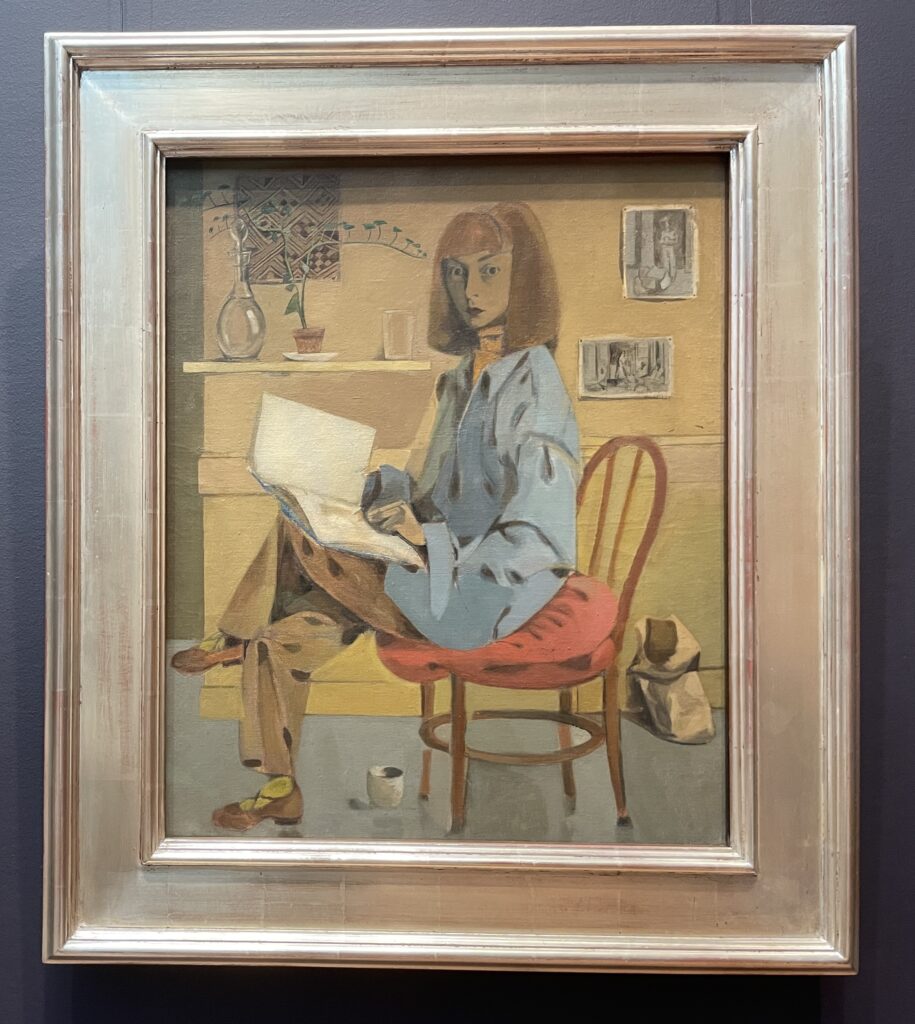
As is the case with other women in this section, de Kooning was the wife of a canonical Abstract Expressionist artist, and largely known as an artist for that reason. However, she differentiated herself from her husband Willem in her range of stylistic skill, from completely abstract to figurative paintings. She was most interested in figurative painting, declaring, “men always painted the opposite sex, and I wanted to paint men as sex objects.” De Kooning’s self-portrait was made as one of multiple at the beginning of her career, as if she anticipated her place in history one day. She depicts herself in a painter’s smock, in the middle of reading or writing.
Lee Krasner (American, 1908-1984)

Krasner never took the last name of her husband Jackson Pollock, rather changed her first name from Lenore to Lee, possibly an effort to combat gendered biases in the art world. She painted in the same Abstract Expressionist style as Pollock, one that functioned as a symbol for freedom and independence, but comparing their work as it is presented in the same gallery by The Museum of Modern Art suggests that this message did not fully resonate with Krasner. Whereas the viewer’s eye travels freely across Pollock’s Number 1A, it circumnavigates Krasner’s crowded and textured composition to realize feelings of confinement and nervousness. Interestingly, Krasner put much of her artistic career on the backburner to support Pollock, but after his death, she began painting larger and more expressive canvases.
Kay Sage (American, 1898-1963)
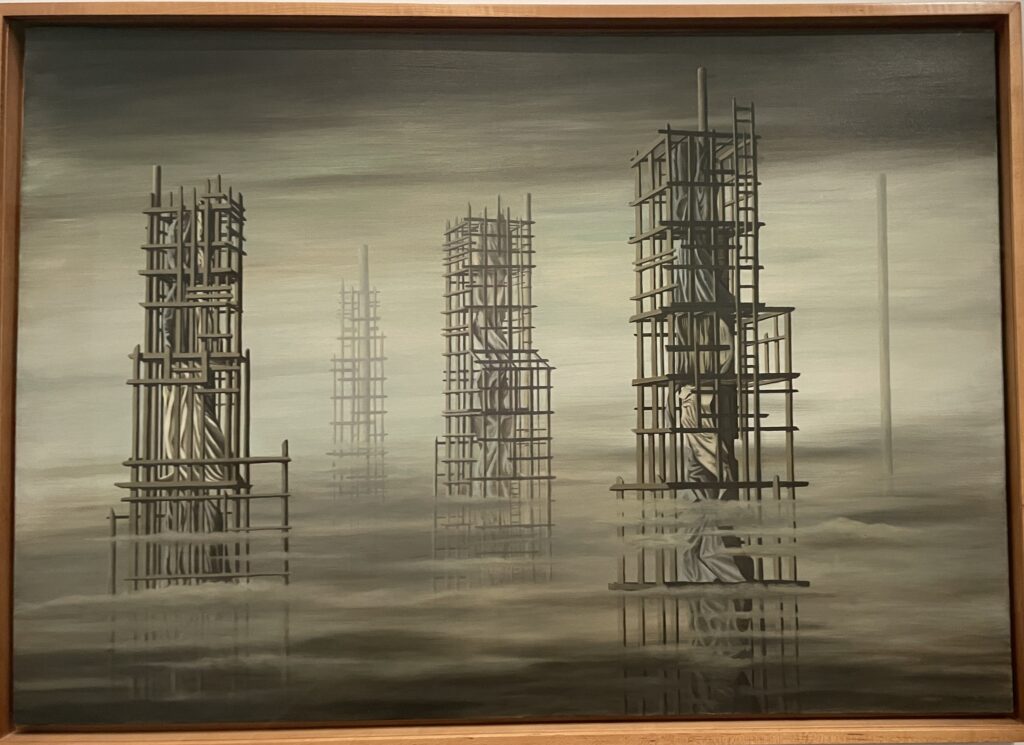
Sage’s painting utilizes landscape to represent her psychological state, in true Surrealist fashion. Wooden scaffolding encloses draped fabric in a loosely bodily shape, most comparable to a classical sculpture in a toga. Evoking feelings of entrapment and hopelessness, this painting was one of Sage’s last works before her death by suicide, however it could also be read as a metaphor for the sentiments surrounding women’s autonomy preceding the Women’s Liberation movement.
Helen Frankenthaler (American, 1928-2011)
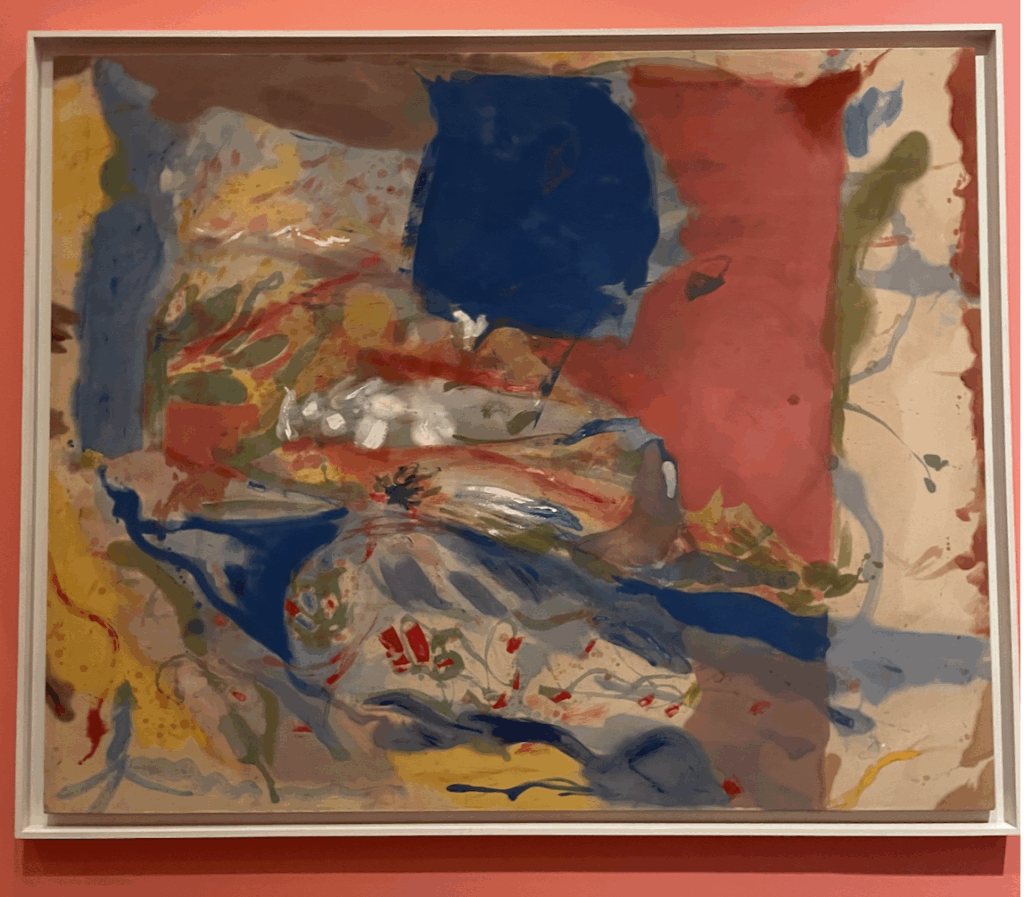

Frankenthaler is one of the most famous female Postwar artists, known for her creation of the “soak-stain” painting technique where she poured paint onto an unprimed canvas and let it soak in. The paint becomes an integral element of the canvas, as women were underlying much of the success of Postwar art, whether as artists, dealers, or wives. Frankenthaler’s later painting Stride takes on a monumental scale, towering above the viewer and dwarfing the other paintings in its gallery at The Metropolitan Museum of Art, as if to solidify its status.
Market Place Gallery, New York, 1959-69
Though now difficult to find any information about online, Market Place Gallery and Book Shop was a vibrant space for exhibition and gathering located in Harlem, and one of the first galleries devoted to African American artists. Uniting all types of Black creation, a 1959 article in the Pittsburgh Courier described the opening for an exhibit of contemporary art at Market Place that included jazz performances and a reading from The Weary Blues by Langston Hughes: “Both painters and jazz musicians, according to the Gallery, ‘work with a consciousness of their rich heritage that has its roots in Africa.’” In fact, Hughes, a leading writer of the Harlem Renaissance, appeared to have had a close relationship with the gallery, bequeathing them in his will contemporary paintings and African art from his collection–evidence that Market Place was an important cultural location. Perhaps Hughes became involved via Market Place’s salons, the types of gatherings employed by earlier elite New Yorkers such as Florine Stettheimer and Helena de Kay (see Modernism Reframed for more).
Ephemera in the Market Place archives at the Schomburg Center heavily consist of external exhibition cards for Black artists, indicating the gallery was opened by its three female founders in awareness of where there was a need in the contemporary art scene. In 1960, Market Place’s exhibit “7 Young Artists” promoted a private showing with proceeds going to the Youth Program of the Harlem YMCA, showing a desire to give back to the local community rather than focus solely on commercial gain. Market Place’s Christmas gift advertisement in a newspaper promotes “Two new books on Africa–the land the whole world is watching” that would have been sold in the gallery’s book shop. The centralization of Africa foresees the eminent Black Power and Black Arts Movements, and the highlighting of literature reinforces that the arts are all intertwined.
“Women’s Lib In The Air”
The 1960s and 70s saw the advent of second wave feminism both in the U.S. and wider world. Fighting for equal rights and opportunities, the movement’s women engaged in progressive art-making, writing, and protesting, their success evident in advancements including the Equal Pay Act, Griswold v. Connecticut, and Roe v. Wade.
Louise Bourgeois (American, 1911-2010)
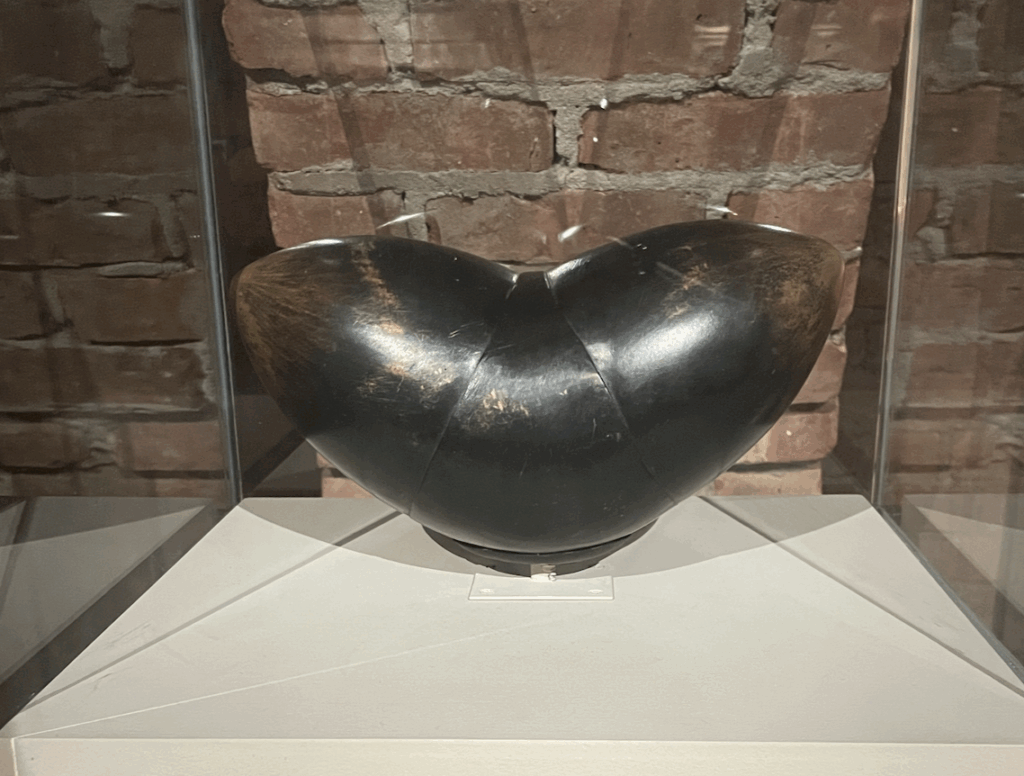
Sculpted in bronze, Bourgeois depicts a breast-like form inspired by reliquaries historically utilized in the Christian tradition to hold the remains of saints. These relics were ascribed a holy property and ritualistically utilized, such as by pilgrims who would travel across country borders just to touch these items. This artwork juxtaposes the holiness of the female body with the sexualization of women, evoked by tarnishing on the sculpture from touch.
Alice Neel (American, 1900-1984)
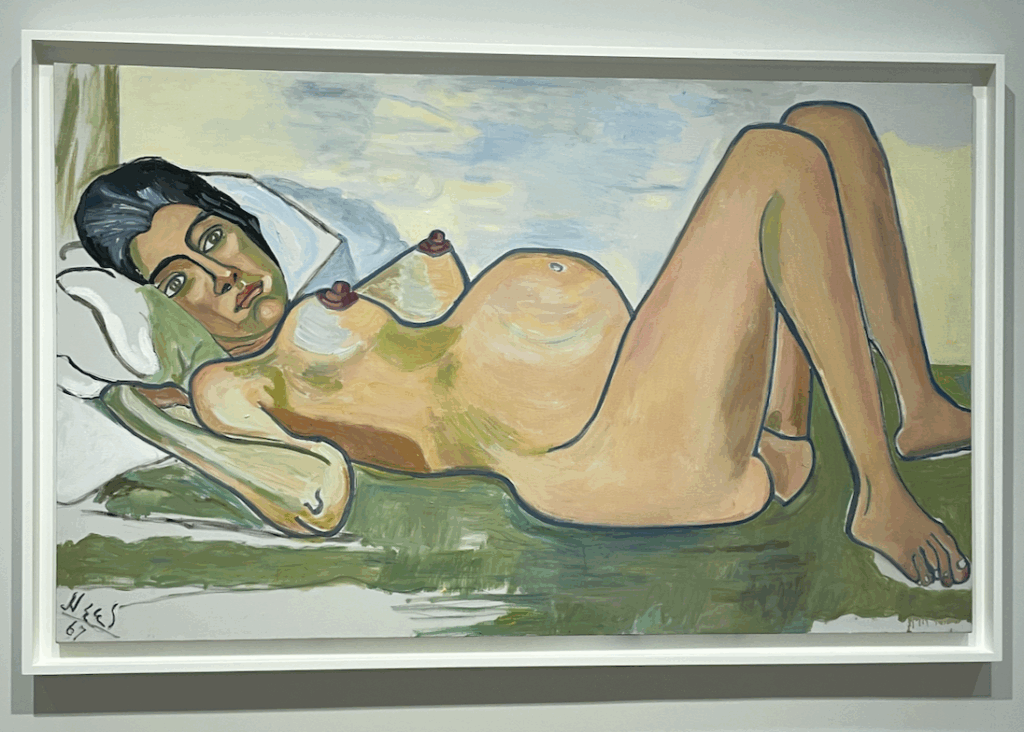
Where depictions of mothers are lacking in art history, depictions of pregnant women even more so are. Refashioning the popular motif of the “reclining nude” in painting, Neel depicts a woman with emphasis on her bulging, pregnant belly in the center of the composition. Her realist style of painting conveys real experiences most directly, in contrast to the predominant styles at the time of Abstract Expressionism, Pop Art, and Minimalism.

Neel is most well known for her portraits, for example depicting Andy Warhol, who is known for his silkscreen prints that appropriate images from consumerist and popular culture. Though an art world powerhouse, Warhol is depicted partially naked with sagging skin, fresh surgical scars, and unaware, closed eyes. Here, Neel upends expectations and creates a raw, humanizing portrait, especially as Warhol was known for disguising himself with wigs and sunglasses.
Marcia Marcus (American, 1928-2025)
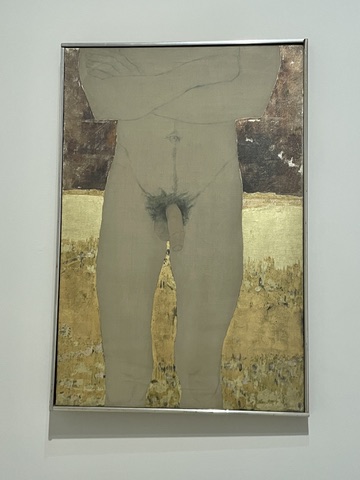
Marcus’ painting of a male phallus is uncomfortable not because it is a nude, but a male nude. While naked women have been painted and sculpted by men throughout all of art history, the inverse has not been true because women were not allowed to draw from life until the late 19th century. Where women’s bodies have been forced to be on display, the male one is now in that vulnerable position. Here, by seeing a man in an objectified position, viewers are forced to confront this unequal history.
A.I.R. Gallery, New York, 1972-Present

A.I.R. Gallery is a non-profit organization that has been operating since the early 1970s with the mission of exhibiting female and non-binary artists–carving out a space for them, when they are statistically underrepresented by museums. In a 1992 doctoral thesis that heavily incorporated interviews of A.I.R. members, the author concluded that women were in search of community and representation.
In addition to solo shows (with some of the heavily repeated names being Mary Beth Edelson, Nancy Spero, and Judith Bernstein), A.I.R. hosted group shows that reached beyond New York, for example exhibiting the female artists of Washington D.C., Native American tribes, Paris, and Japan. In a 1973 review of “Invitational: Women artists from Washington, DC” in the Washington Star News, the author aptly wrote that “there is just a touch of Women’s Lib in the air.”
The shows A.I.R. Gallery put on in its early years were forward thinking in that they remain relevant today. A 1974 solo show for Sylvia Sleigh included the same exposing male nudes shown in 2025 at Lévy Gorvy Dayan, and a 1976 A.I.R. exhibition catalogue describes the feminist nature of fiber arts, something argued by The Museum of Modern Art in their 2025 exhibition Woven Histories: Textiles and Modern Abstraction.
In May of 2025, A.I.R. Gallery announced that their 2025 National Endowment for the Arts grant was terminated due to misalignment with the federal administration’s priorities. Yet, recent studies have shown that the prominent American museums represent 87% male artists, and the volume of museum acquisitions for female artists peaked back in 2009. What should the nation’s artistic priority be if not representing the cultural achievements of women proportionate to their population?
Alma Thomas (American, 1891-1978)
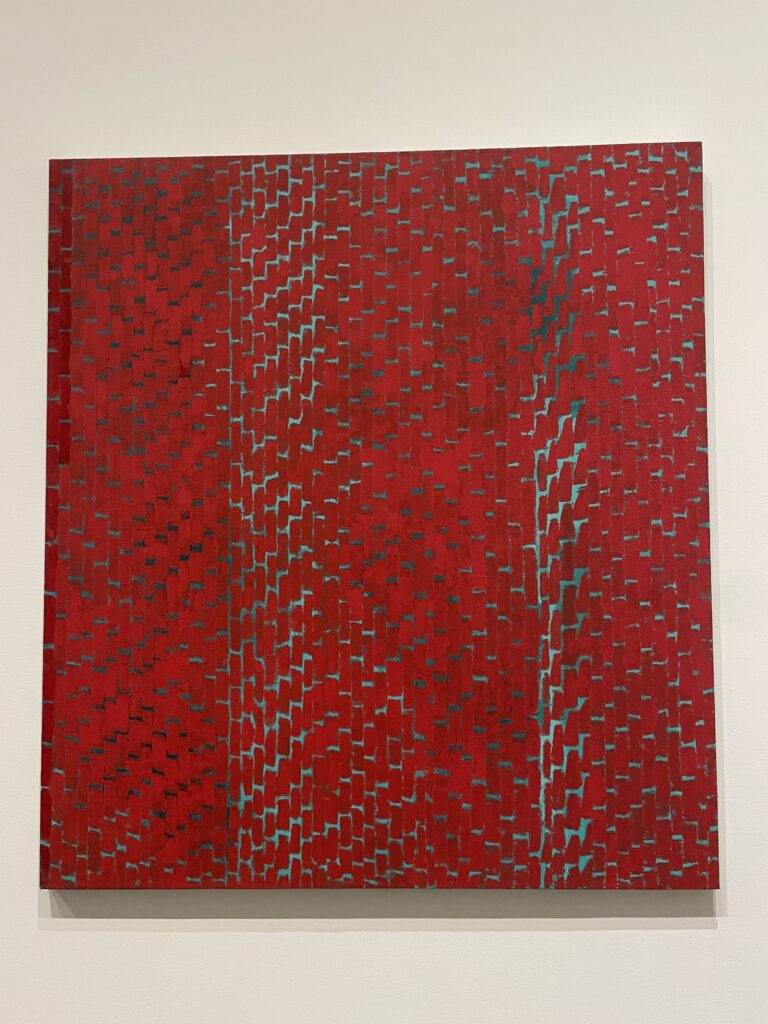
Thomas’ abstract compositions are easily distinguishable for their vibrant colors and swatches of overlaid color. She is a figure to know in art history, as the first African American woman to have a solo show at the Whitney Museum of American Art and to enter the White House’s art collection. Rather than depicting the political struggles of Black women, as is often an unfair expectation of them, Thomas responded to the era’s social and political unrest by concentrating, in her own words, on “beauty and happiness, rather than on man’s inhumanity to man.” Her endeavor certainly manifests in this painting through its musical name and rich red pigment.
Judy Chicago (American, b. 1939)


Chicago’s monumental installation, The Dinner Party, is probably the most famous artwork of the feminist movement. She sets a triangular dinner table with embroidered placemats and plates painted with vaginal designs for 39 important women throughout history, in effect challenging the idea of greatness or a few sole “greats.” However, The Dinner Party does not come without controversy, even today. While some people think Chicago is reclaiming the vagina as a place of power and pleasure, others think that it is reductive. Further, the table recognizes predominately white figures, and women of color have different designs on their plates, including African-style masks for Sojourner Truth; Black female bodies are not visualized.
Harmony Hammond (American, b. 1944)

The earliest feminist works by Hammond, a founding member of A.I.R. Gallery, were often concerned with materiality, as evident in Pink Weave’s use of oil and wax to mimic a woven textile. The artist creates a dually feminist message, challenging the male dominance of abstract art by elevating fiber art, a form that was long dismissed as domestic work.
Black Arts Movement
Many Black women felt that their needs were sidelined during the second-wave feminist movement, leading to further efforts for equality. In one of these efforts, the Black Arts Movement (BAM), starting in mid-1960s America, radicalized and subverted Western history through its reconsideration of artistic methods.
The BAM directly addressed the needs and aspirations of the contemporary Black Power Movement, which, in the words of prominent activist Stokely Carmichael, sought to “reclaim our history and our identity from the cultural terrorism and depredation of self-justifying white guilt.” Essentially, these self-determining movements worked to divest from white systems of value and embrace collective endeavors for a Black audience. Ideally, the destruction of Western aesthetics through the embrace of Black art forms would fundamentally promote revolution.
Jack Whitten (American, 1939-2018)

In Whitten’s words, “The search for identity led me to carving wood.” Many of his wooden sculptures appear to be punctured with metal objects, such as nails and tools, a clear visual reference to the Kongolese power figure called a Nkisi N’kondi. Minkisi are unique to the 19th century because of Central Africa’s relation to colonization and violence, which may be where Whitten’s inspiration comes from; he is concerned with processes of reconstructing fragments, a focus originating from histories of enslavement. In light of this context, it is not immediately obvious why Whitten would name one of these sculptures John Lennon Altarpiece. However, given the historical context of the time, it seems to say something about the die-hard passion people had for celebrities while there were larger societal issues they could have been focusing their energy on.
Barbara Jones-Hogu (American, 1938-2017)
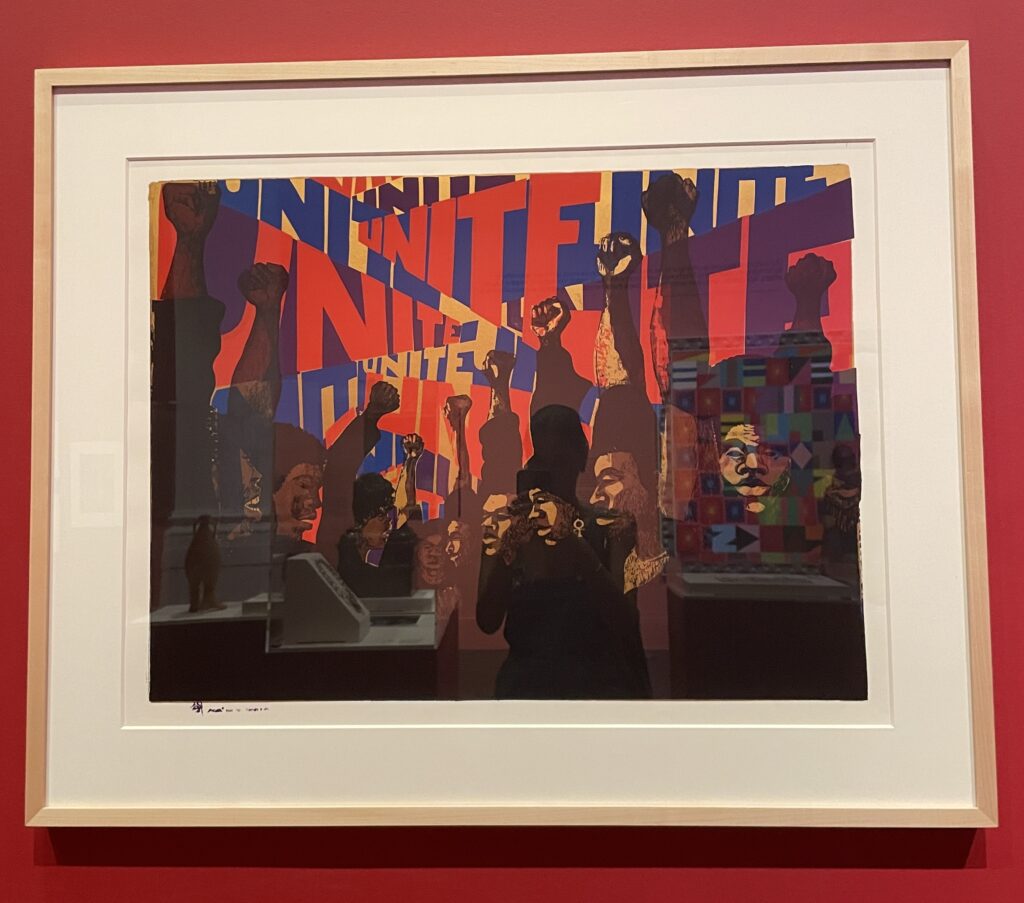
Unite is a prime example of how the BAM sought to empower Black communities. It has an easily-deducible message; the word “unite” is repeated in the negative space, while figures raise their fists in resistance and solidarity. The simplicity of these visual elements easily conveys a pressing need for action. Further, the print medium would have been low-cost and easily reproducible, ideal for wide dissemination. The composition of Unite aligns with art-making guidelines established in 1970 by AFRI-COBRA, a prominent Chicago BAM collective of which Jones-Hogu was a founding member. The group believed that Black art “should define the past—through a consideration of African heritage; identify the present—in contemporary black heroes; and offer direction for the future—with images of the black family.”
Betye Saar (American, b. 1926)


A Just Above Midtown artist, Saar is innovative for her use of assemblages and mixed media that recontextualize objects and images from mass culture. I’ve Got Rhythm places a black skeleton on a metronome’s pendulum, so that it is jolted back and forth in front of an image of a white crowd. The metronome’s cover is pasted with newspaper headlines describing horrific acts of violence against African American people throughout the first half of the 20th century. Saar’s metronome is perhaps a reference to Man Ray’s Indestructible Object, where he pasted a cut out image of his ex-lover’s eye onto one of these tools and let it tick to the limit of his endurance, then destroyed the object in a single blow of a hammer. The overall message conveyed by Saar is about the white American population’s reductive view and mistreatment of Black people while still deeming themselves proud patriots and Christians.
Just Above Midtown (JAM) gallery, New York, 1974-1986

Just Above Midtown was founded by Linda Goode Bryant to create a space for the display of work by Black artists. It was partially funded by the National Endowment for the Arts, where smaller organizations predominated the 144 institutions that received grants. In addition to showing art, JAM hosted programming, such as “The Business of Being an Artist” series that had workshops covering topics from making portfolios, applying for grants, mounting exhibitions, culminating in an exhibition that showcased what the artists learned. A series of seminars in 1983-84 included presenters like feminist critic Lucy Lippard and artist Alice Neel. Another seminar was an Afropop series of exhibitions and performances examining Black pop culture from the turn of century to the present, including a talk by prominent BAM writer Amiri Baraka, suggesting the compounded power of the arts when banding together.
Howardena Pindell (American, b. 1943)

Pindell’s work is primarily abstract, an example of the “burden of representation”: Black artists do not just have to make art about being the Black, as is the case for women artists, Indigenous artists, etc. Rather, Untitled is striking for its raw quality: it has a raised, uneven texture, and is nailed directly to the wall.
Pindell was highly involved in organizations that supported women and Black women artists. She was a founding member of A.I.R. Gallery, a panelist for an art and ethics series at JAM in 1983-84, and would go on to create an organization in the 1990s called “Entitled: Black Women Artists” that supported inclusivity in the arts. “Entitled” can be seen as a testament to the legacies of the BAM, where their mission was to promote art for women of African descent. In fact, minutes from a May 1998 meeting congratulate one of the members’ publication of a book they wrote that was about the emergence of Black women artists in 1970s New York. In a straightforward attitude reminiscent of the Black Power Movement and relevant today, “Entitled” wrote long letters to the Cooper-Hewitt National Design Museum and New York Times critiquing their lack of representation and funding for artists of color.
Melvonna Ballenger (American, 1954-2003)
From the late 1960s to the 1980s, a group of young filmmakers known as the L.A. Rebellion produced work, starting at UCLA, to document Black lives. The group’s ideological origins are in the Watts Rebellion of 1965, which were riots over racial discrimination and police brutality. To serve the population directly, the L.A. Rebellion artists had the goal of humanizing Black people in film and rejecting mainstream practices to break free from the dominant cinema in America that excluded and misrepresents minorities. A prime example of the Rebellion is Ballenger’s short film Rain (Nyesha). The protagonist lives a mundane life, without agency, but the capitalist labor structure, represented by the white boss, has trapped her and is imposing surveillance over her. When the thunder strikes to break this cycle, the protagonist makes change a reality; she is miserable until she can face the allegorical rain with a like-minded community, helping viewers imagine how they can affect change in their own lives.
Ecofeminism
With the environmental movement of the 1960s and 70s came a sect aligned with feminism.
Ana Mendieta (Cuban-American, 1948-1985)

The words in Mendieta’s Amategram Series are painted on amate, a bark paper used in Indigenous Mexican Otomi ritual. Her vaginally-coiled, painted form evokes female life, something Mendieta saw as omnipresent in nature. Together, these elements demonstrate the synchronicity of Indigenous ways of honoring the earth and the physicality of divine feminine power.

Mendieta’s sand sculpture is designed to the scale and shape of the artist’s body, but serves as a wider metaphor for the universal female body. She considered her artmaking practice, which often included making bodily imprints on the earth or its materials, a “‘return to the maternal source,’” especially on a global scale, given that she was exiled from Cuba for most of her life. The association with women and nature is a nuanced one: it is instinctive because of their shared reproductive abilities, but then that can be seen to reduce women to the role that oppressed them.
Agnes Denes (American, b. 1931)
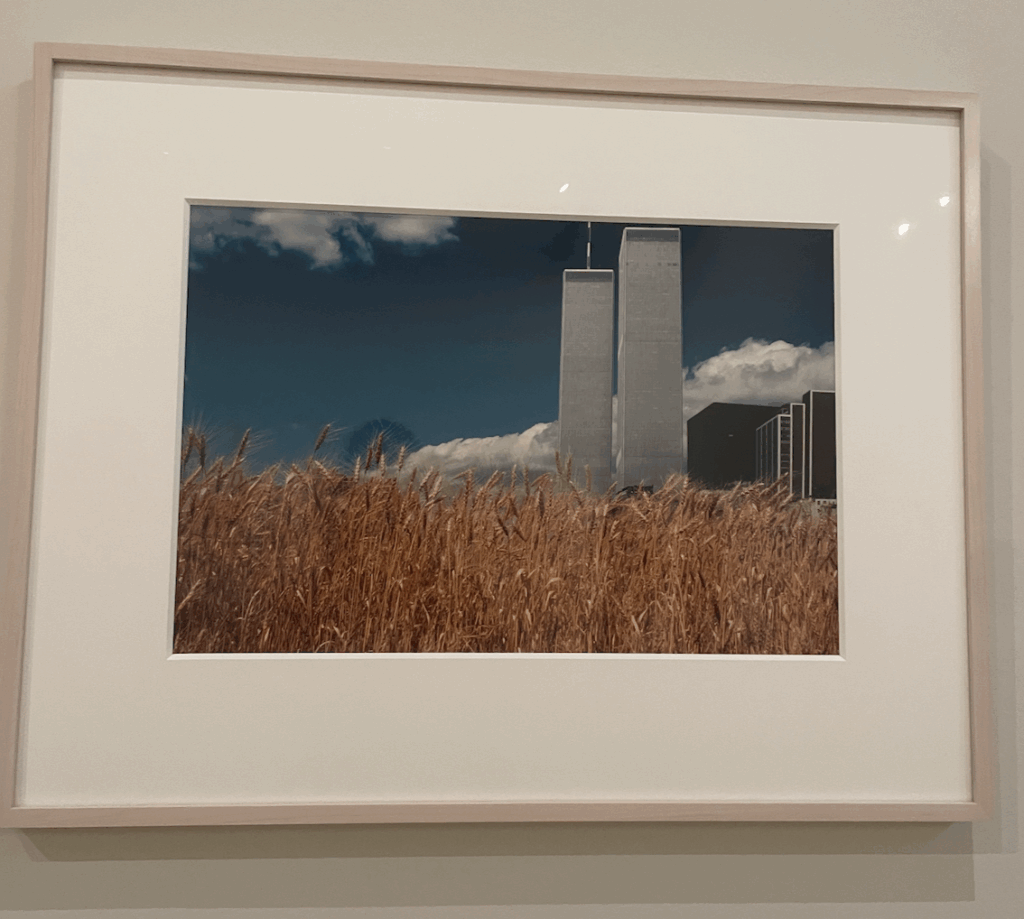
One of the founding members of A.I.R. Gallery, Denes embarked on land-art endeavors with tangible messaging. In Wheatfield – A Confrontation, she filled Battery Park Landfill with 2 acres of seeds, nourishing them over the course of four months to yield 1,000 pounds of wheat. In the words of the artist, “Wheatfield was a symbol, a universal concept; it represented food, energy, commerce, world trade, and economics. It referred to mismanagement, waste, world hunger and ecological concerns. It called attention to our misplaced priorities.” In a female-associated act of nurturing, Denes critiqued humans’ mistreatment of the world and its citizens while starting change.
Indigenous Perspectives
The Red Power Movement of the 1960s and 70s encompassed the main fight of Indigenous Americans for self-sovereignty and anti-discrimination.
Fritz Scholder (American/Luiseño, 1937-2005)
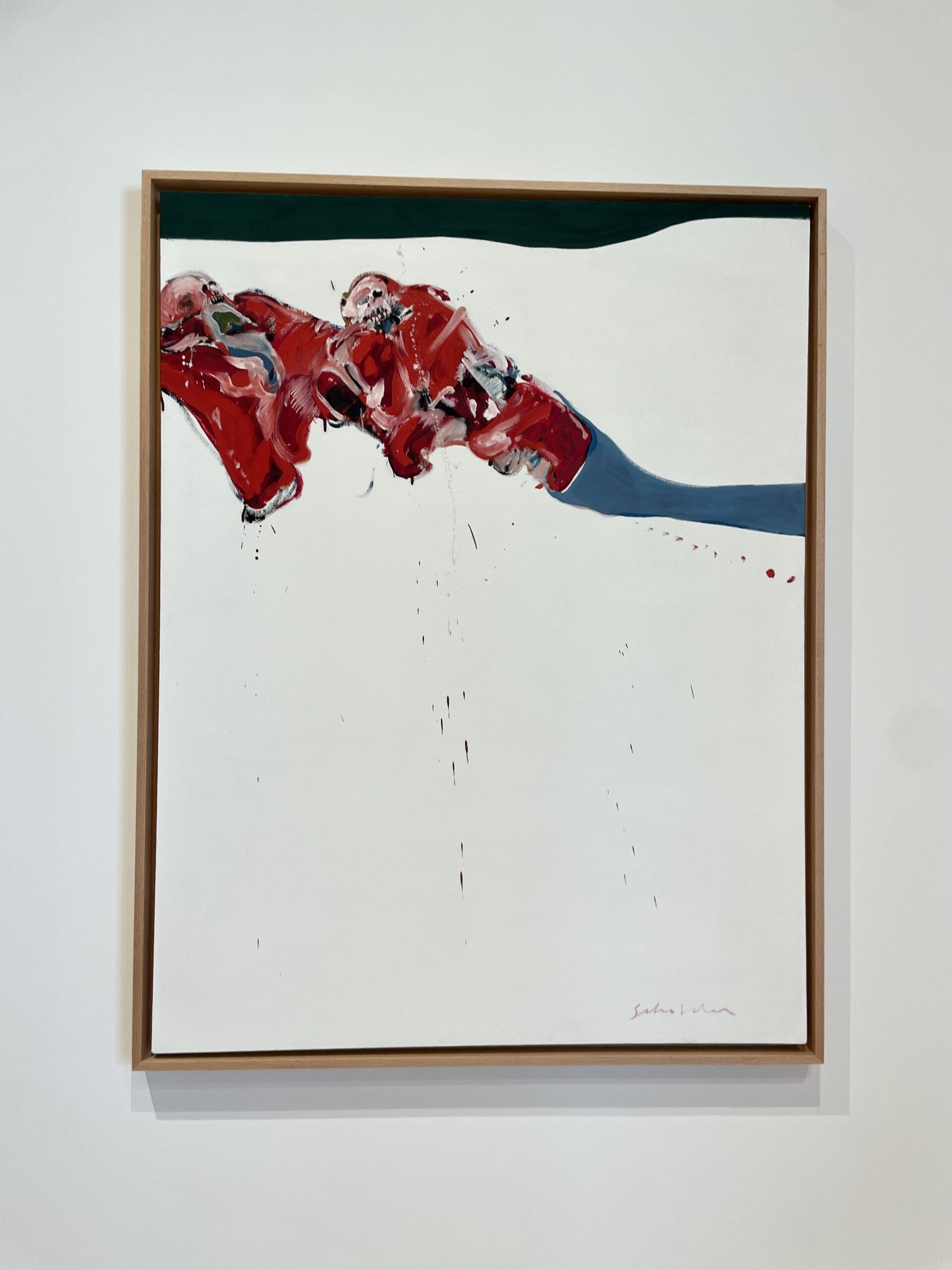
One effort within the Red Power Movement was the 1973 Wounded Knee Occupation, a 71-day protest in South Dakota in response to broken treaties and corruption of governing bodies. The site was historically relevant for an 1890 massacre of hundreds of Lakota people that occurred there at the hands of U.S. troops, which was the inspiration for this painting by Scholder just a few years before the Occupation–not a coincidence so much as a demonstration of the enduring effects of colonial oppression. Scholder referenced photographic documentation of the massacre, but produced an abstract rendering of it. He creates a visceral representation of violence with organ-like red hues and strokes and splatters that stand out from the white background.
Kay WalkingStick (American/Cherokee, b. 1935)

WalkingStick produced a series of silhouette portraits, their anonymity standing in for her various identities as a woman, mother, artist, and Indigenous person. Subtle details of the painting allude to environmental issues: the blue rectangle in the background is a reference to one of WalkingStick’s paintings that was made in response to air pollution, and the acidic green dominating the composition conveys environmental catastrophe as much as it does sensuality. Indigenous peoples are some of the first to face the repercussions of climate change due to their close relationship with the environment and climate change’s exacerbation of preexisting issues of political and economic marginalization.
Legacies of the BAM
While the main focus of this page is the Postwar era, many of its themes are still relevant in contemporary art and life. Thus, recognizing this continuity helps create a more complete picture of Postwar artists’ legacies and relevance in art history.
Faith Ringgold (American, 1930-2024)
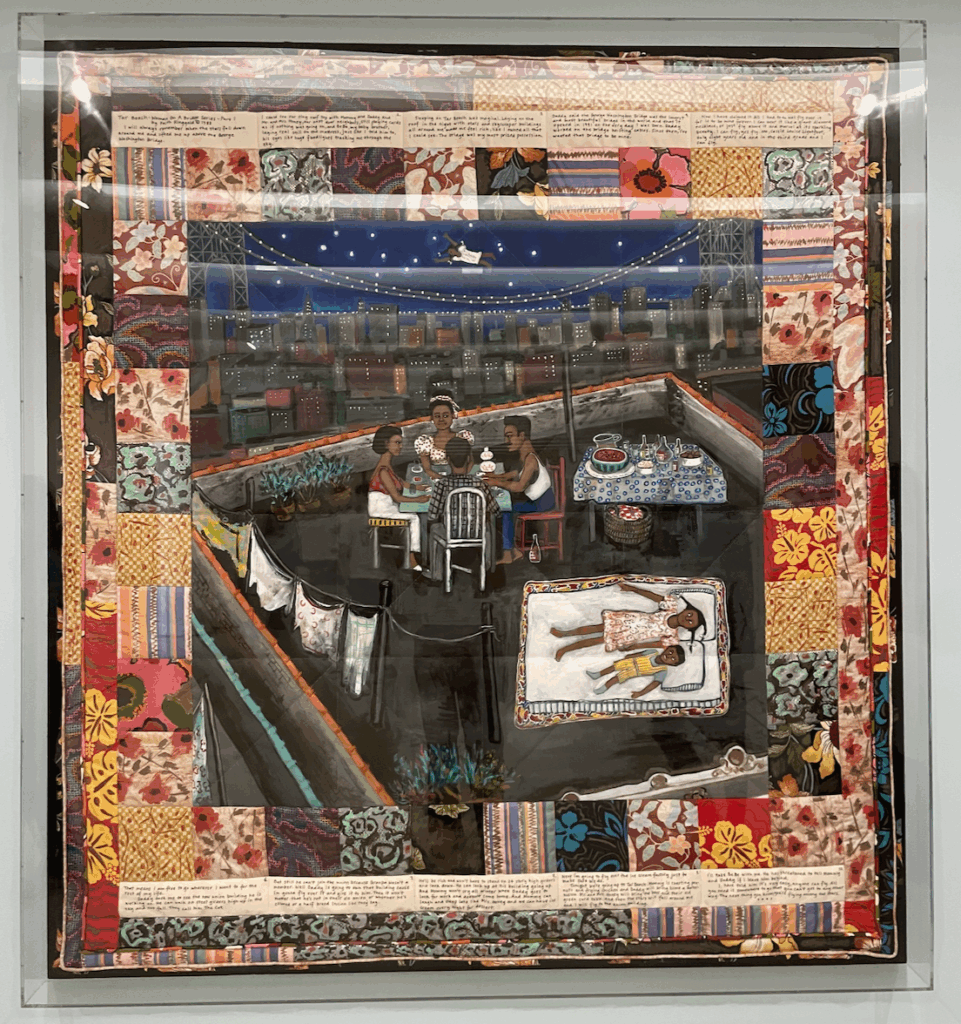


Ringgold was producing political art in the BAM era and a proponent of one of the first formal exhibitions of Black female artists, in 1971. However, she is most celebrated for her figurative quilts picturing topics related to the Black American experience, which while produced after the BAM ended, are still highly relevant to its aims. Her textile use subverts the domestic association of the medium, especially given that it is highly complex with figurative imagery and a written story.
Tar Beach depicts a fictitious girl with the ability to fly, a reinterpretation of “flying African” folklore. The central image is flanked by writing from the perspective of the girl, claiming the George Washington Bridge as her own and sharing hopes about her working class father. Though fictitious, the writing comes off as deeply personal, evoking aspiration, kinship, and struggle.
Lorna Simpson (American, b. 1960)

Simpson’s career was launched with the help of Just Above Midtown gallery, and now she is the subject of a recent solo show at The Metropolitan Museum of Art called “Lorna Simpson: Source Notes.” Three Figures utilizes imagery from a 1963 photograph of Black demonstrators being sprayed with a high-pressure hose by police in Birmingham, Alabama, during the civil rights movement. By recasting this moment, Simpson reclaims African American history in alignment with the BAM’s goals.
Lauren Halsey (American, b. 1987)

Though Watts was the epicenter of the L.A. Rebellion, its significance in Black culture has not disappeared in the current era. Halsey’s ultra-contemporary installation incorporates slogans and imagery from around Watts in order to recognize its shaping of the people who live there, beyond the riots that put it on the map. A theme throughout the piece is community building, carrying on the same message as works like the L.A. Rebellion’s Rain (Nyesha).