While New York’s position as the center of the art world was not solidified until the Postwar era, there is evidence in the decades leading up to that of women artists, dealers, and tastemakers who helped it reach that status.
Foundations
Covering a range of subjects, from grand portraiture to nudes, these are some pioneering women who proved painting was not just a man’s realm starting in the 19th century.
Helena de Kay (American, 1846-1916)

Though a seemingly unremarkable sketch, this nude study is highly significant because it was painted in the year that life classes were first open to women at the National Academy of Design. Priorly, it was deemed improper for women to paint nudes from life, leaving them at a disadvantage compared to their male counterparts; nudes were often incorporated into history and genre paintings, two of the preeminent subjects of the time according to Academies.
Though a capable painter and illustrator, de Kay is better known for her position as a tastemaker in New York. She held weekly salons, uniting writers, artists, and actors to discuss the latest happenings and trends in the art world. Salon culture became prominent in the Enlightenment era as a reflection of its ideals, but remained relevant at the hands of women who hosted these gatherings, in effect uniting women’s private homes with the intellectual sphere usually reserved for men.
Cecilia Beaux (American, 1855-1942)

Beaux’s life-sized portraits commissioned by wealthy patrons are immediately comparable to those by John Singer Sargent, which hang in the same gallery as Mr. and Mrs. Anson Phelps Stokes at the Metropolitan Museum of Art. This was the same similarity that Beaux’s contemporaries drew, albeit they ranked her below Sargent due to her supposedly more feminine and sympathetic representations. Yet, Mr. and Mrs. Anson Phelps Stokes is arguably more complex and powerful than Sargent’s comparable portrait, Mr. and Mrs. I. N. Phelps Stokes. Beaux foregrounds the woman and depicts her writing, while simultaneously turning toward the viewer as if interrupted, versus her husband who appears far more posed and sedentary.
Mary Cassatt (American, 1844-1926)

When one tries to think of popular representations of mothers and children in art history that are not religious, Cassatt is often the only figure they can name. Young Mother Sewing depicts a middle or upper class woman in her home, intently stitching fabric, while her daughter leans on her knee and gazes discontentedly at the viewer as if to tell them she cannot get her mother’s attention. Rather than an idealized image, such as the humble Madonna, Cassatt captures a realistic image of domesticity, centering maternal labor. In fact, the two models are unrelated, underscoring the carefully composed representation of childcare.
Young Mother Sewing was showcased at Knoedler’s Gallery in 1915 for an exhibition organized by New York collector and philanthropist Louisine Havemeyer to support the women’s suffrage movement; both women were active in the fight for women’s rights. Giving remarks on the exhibition, Havemeyer is quoted as saying, “‘How often have friends said to me: ‘Won’t you ask Miss Cassatt to paint my little girl?’ I would like to have her painted just like that.’ Well, the ‘just like that’ means years of study and observation and a large proportion of artistic insight added to the recipe.” These words emphasize Cassatt’s intentional and academic approach, combating the stereotype at the time that women artists were amateurs. Havemeyer purchased the painting in 1901, bequeathing it to The Metropolitan Museum of Art after her death in 1929. It was then one of the only paintings by a woman artist in the museum’s collection, and can still be seen there today, having withstood the tests of time.
Theresa Bernstein (American, 1890-2002)
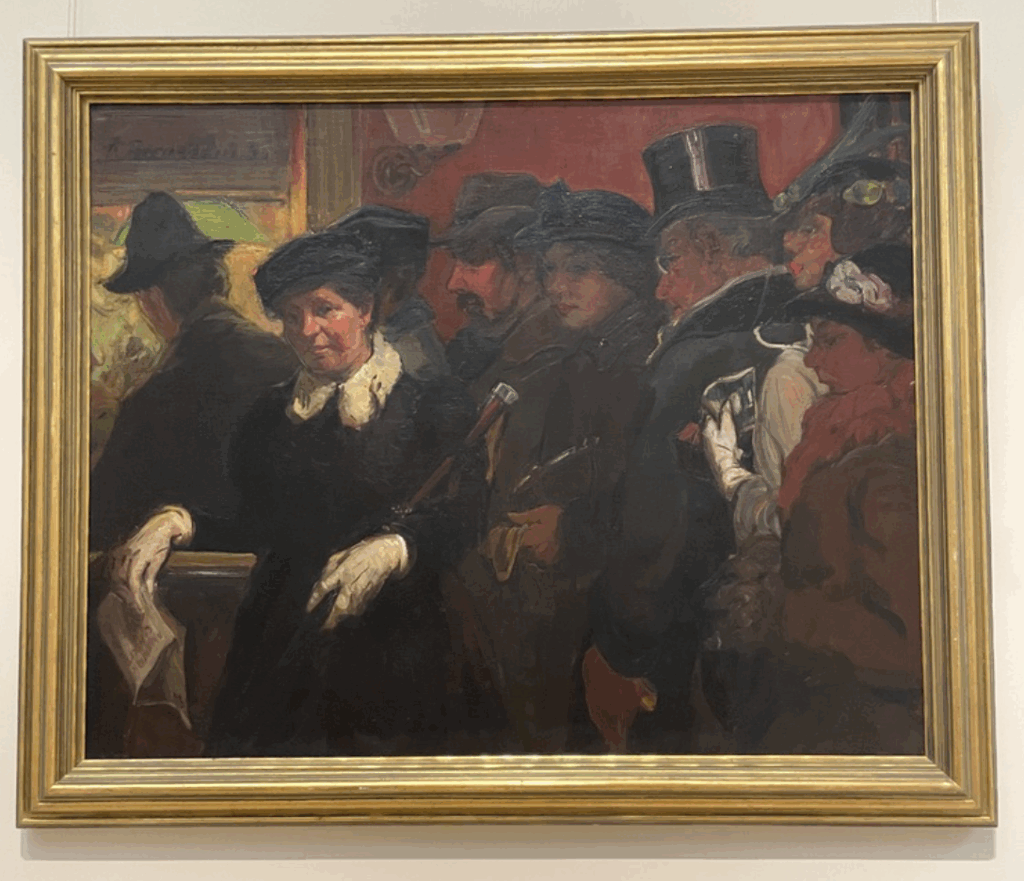
In an era where chaperones still existed (adults who accompanied unmarried women in public), Bernstein, an unmarried woman at the time, created an intimate composition of a public gathering, subverting the accepted spheres for women. The painting depicts a crowd of patrons entering the Metropolitan Opera, certainly a scene Bernstein would have encountered in life and later depicted from memory. Bernstein would have been educated on contemporary European artists she encountered abroad, and she depicted social causes she supported including women’s rights and immigrant rights.
Making NYC
Upper Echelon Society
Hilla Rebay (German, 1890-1967)


Rebay is a need-to-know figure in art history, as both an artist and the first director of the Guggenheim Museum (then called the Museum of Non-Objective Painting), now one of the most major museums of modern art in the world. The first exhibition held at the Museum of Non-Objective Painting was called “Art of Tomorrow” (1939), the title itself even setting the tone for what was to come: avant-garde, abstracted compositions, perhaps even too shocking for the inhabitants of bustling New York. The exhibition brochure honors the artists who began to pioneer Modernism half a century prior and declares that this type of painting is superior to all others in terms of its cultural value for its ability to resonate with individuals regardless of their artistic knowledge.
The exhibition brought together numerous paintings by now canonical artists, including Wassily Kandinsky, Paul Klee, and Fernand Léger. However, other exhibitions at the Museum of Non-Objective Painting looked inwards: in 1949, an exhibit was held here with over 200 works by Rebay herself. So many works, in fact, that some galleries stacked three or four rows of them on top of each other. The primary medium of the exhibition was watercolor, though supplemented with many examples of collage. These are mediums traditionally more accepted for women, yet, Rebay masterfully painted in the geometric style of Modernists. The introduction to the exhibition catalog sings Rebay’s praises. It explains that this is the work of almost 40 years, because like all great artists, Rebay was too busy teaching and financing other artists to promote herself. The 1949 exhibition was supposedly requested by the public, a believable fact considering Felix Fénéon, the foremost of French art experts, called her the greatest woman painter, and her Salon for Non-Objective Painting in Paris was spoken about for years after.
Peggy Guggenheim (American, 1898-1979)


In mentioning the Guggenheim, it would be remiss not to highlight Peggy Guggenheim, the well-known collector now with a museum in Venice. In 1942, Guggenheim opened her first U.S. gallery, located on West 57th Street, calling it The Art of This Century. It consisted of four galleries dedicated to abstract art, Surrealist art, and kinetic art, and commercial sales. In contrast to the white cube aesthetic popularized in the 1930s by the Museum of Modern Art, The Art of This Century included undulating walls and paintings suspended in the middle of rooms, a futuristic curatorial choice that would remain unparalleled, but certainly apt for the innovative paintings she showed.
One year after opening The Art of This Century, Guggenheim opened her groundbreaking exhibit, “31 Women,” the first show in the U.S. of only female artists. As would be the case for all her exhibits, Guggenheim selected the artworks alongside a jury of prominent figures, including Marcel Duchamp, André Breton, and James Johnson Sweeney. Among the successful artists would be a number still highly prominent today, including Leonora Carrington, Frida Kahlo, Louise Nevelson, Meret Oppenheim, Hedda Sterne, and Dorothea Tanning. Only one woman declined the jury’s invitation to be in the show–Georgia O’Keefe, saying she was not “‘a woman painter’” (a term that would later be embraced by the feminist A.I.R. Gallery in the 1970s). At least seven of the artists were wives of or prior girlfriends of famous male artists, suggesting that their lack of representation can be boiled down to a gendered separation. The show was not a commercial success; only three works sold. Critics had mixed reviews, almost all of them focusing on gender. Yet, this was undoubtedly a trailblazing moment in feminist art history.
Until The Art of This Century closed in 1947, Guggenheim held exhibitions in support of male and female artists alike. In 1945, she held another all-female show, called “The Women.” Unfortunately, it received less critical attention than “31 Women” and no works sold, perhaps indicating that the former exhibition was intriguing because it was unprecedented. Yet, this was not the extent of Guggenheim’s efforts. While men outnumbered women in terms of solo shows at the gallery, this was not by a huge margin. For every few male solo shows there would be one by a woman, and in the end, almost forty percent of artists who exhibited at the gallery were women–a statistic unparalleled in many institutions today. Women were heavily included in group shows, and on the other end, over 30 female collectors bought works from the gallery. It seems that Guggenheim supported both genders, but it was just the men that history remembered. In fact, Lee Krasner was offered a spot in “The Women,” not long after her husband Jackson Pollock’s first solo show at the gallery that would end up being the foundation for his place in the canon. When Pollock could barely sell a painting, Guggenheim continued to show his work and pay him a monthly allowance. Guggenheim was a true patron of the arts: supporting artists when the public would not, regardless of their gendered expectations.
Florine Stettheimer (American, 1871-1944)

Though a name seldom taught in art history, the female artist appearing most frequently across the New York City museums is Stettheimer, with works on display at The Metropolitan Museum of Art, Whitney Museum of American Art, and Museum of Modern Art. At The Met is her “Cathedrals” series, a collection of four monumental paintings made over a decade honoring the quintessential consumerist, financial, artistic, and theatrical corners of high society New York. These are crowded compositions, comprising major figures, establishments, and the artist herself. Where patriotism is usually a male attribute, Stettheimer utilizes reds, whites, and blues in her glamorized pictures. Her paintings at the other museums are smaller scale, one a frilly portrait of her mother and the other a bouquet of flowers. Though more traditionally “feminine” in their subject matter, Stettheimer’s paintings show a high degree of technical skill and a dreamy quality reminiscent of Surrealism.
The largest number of Stettheimer’s works are located at Columbia University’s Avery Art Properties, and the collection does not disappoint. One striking pair of works are two portraits of women painted at different points in Stettheimer’s career. The earlier one depicts a woman posed primly, while the later one shows an androgynous woman with short hair posed comfortably, reflecting shifts towards more free-thinking attitudes. Another interesting painting includes a depiction of a person of color: a young Black girl presents a fruit platter to a blonde girl with a downturned expression. While the Black figure appears in a position of servitude, she is given a name, something that did not happen in Édouard Manet’s famous Olympia.


My favorite painting from my visit to Avery Art Properties was Stettheimer’s imaginative portrait of her sister Carrie, the one who ran the household, as reflected by her authoritative and animated position in the foreground, while her family is seen dining behind her. In the left of the composition is a dollhouse, a real project by Carrie that she intricately crafted, down to miniature embroidered hand mirrors. This dollhouse is not just indicative of women’s spheres, but is an extension of Carrie’s responsibilities and passions which she took seriously. One room of the dollhouse is a gallery including miniature artworks by real artists, including a painting by Marcel Duchamp. In real life, Carrie was central in organizing salons at the Stettheimer home, which were attended by prominent figures including Duchamp, Alfred Stieglitz, and Leo Stein. Florine would display her paintings around the home, undoubtedly exchanging artistic ideas with canonical artists.


The Harlem Renaissance
In the 1920s and 30s, following the Great Migration, there was an explosion of artistic creation by African American artists working in New York, showing the need for Black art apart from white standards. Women in the visual arts were no exception to these contributions. Other Harlem Renaissance figures maintained prominence throughout the 20th century, including Langston Hughes, who can be read about in the Postwar Art Reframed section.
Laura Wheeler Waring (American, 1887-1948)

In this anonymous portrait, Waring depicts a young girl with a bowl of pomegranates. Pomegranate production had declined in the 1930s from a lack of demand, instead more so resonating with historic representations of the fruit, including by Sandro Botticelli and Rachel Ruysch, thus possibly depicted to raise the status of the sitter. Where the painting’s background and props appear static, the sitter does not: the chair in which she is seated is visible, and she confronts the viewer with a knowing glimmer in her eyes.
Augusta Savage (American, 1892-1962)

In the late 1930s, Savage was commissioned to create an artwork for the World Fair, a major event that showcased cultural and industrial achievements from nations around the world. She created a monumental bronze sculpture in honor of composer, activist, and lawyer James Weldon Johnson, where she was inspired by a poem he wrote. The sculpture was an enormous success, with reproductions being sold at the fair.
Latin American Art in the City
In the early 20th century, Latin American artists were producing innovative Modernist artworks in response to growing industrialization and technological advancements, so it is unsurprising that they resonated with New York City audiences.
Abby Aldrich Rockefeller (American, 1874-1948) and Diego Rivera (Mexican, 1886-1947)
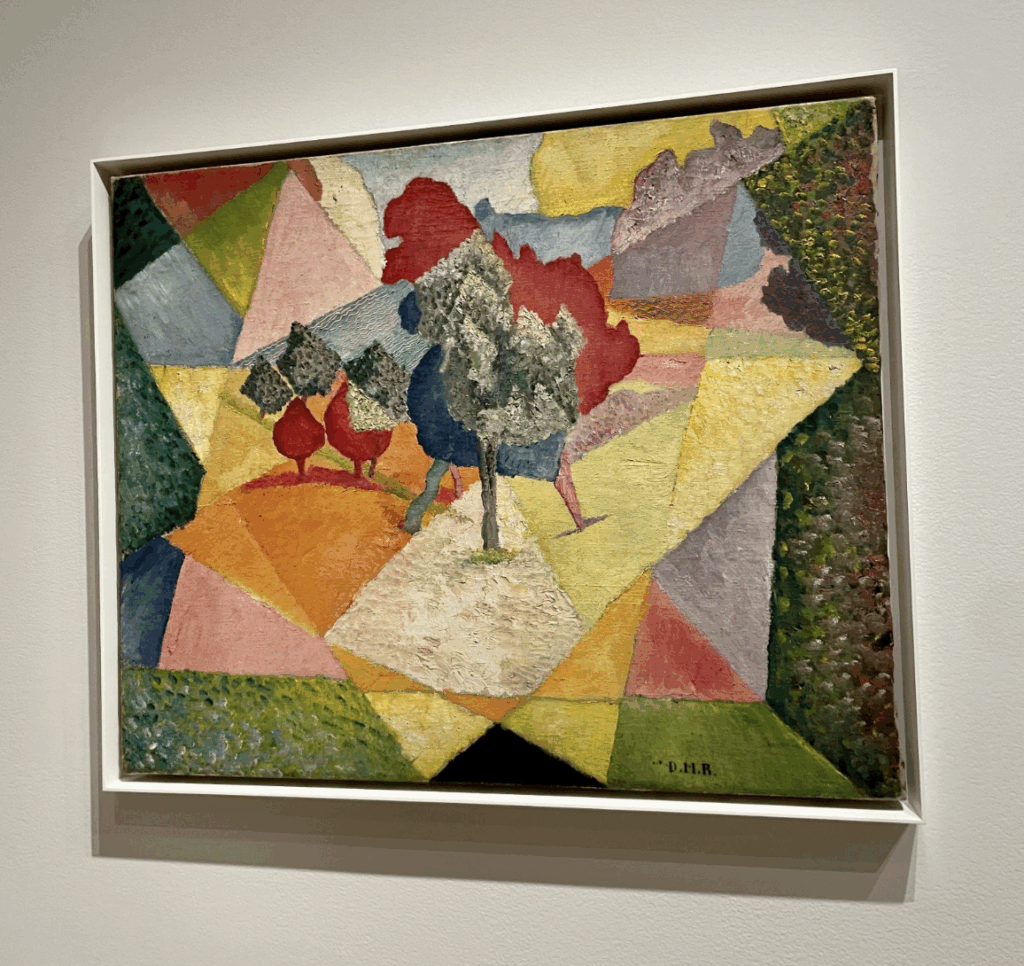
Rockefeller, a prominent socialite and philanthropist, was one of The Museum of Modern Art’s founders in 1929 despite being a woman. The MoMA’s second single artist exhibition, after Henri Matisse, was Rivera. This was an unusual choice, as Rivera was earlier in his career, not to mention Mexican and a Marxist, but he had a successful exhibition of murals, with the help of Rockefeller advocating for him. The exhibition broke attendance records, and was heavily ingrained with commentary on social issues that could resonate with wide New York audiences. Rivera embraced his Mexican identity across his work, saying that his Cubist paintings (a French movement) were his “most Mexican” due to their vibrant colors and geometric patterns, including ones now on display at MoMA. Together, Rockefeller and Rivera changed the possibilities for the New York art scene.
Leonora Carrington (British-Mexican, 1917-2011)
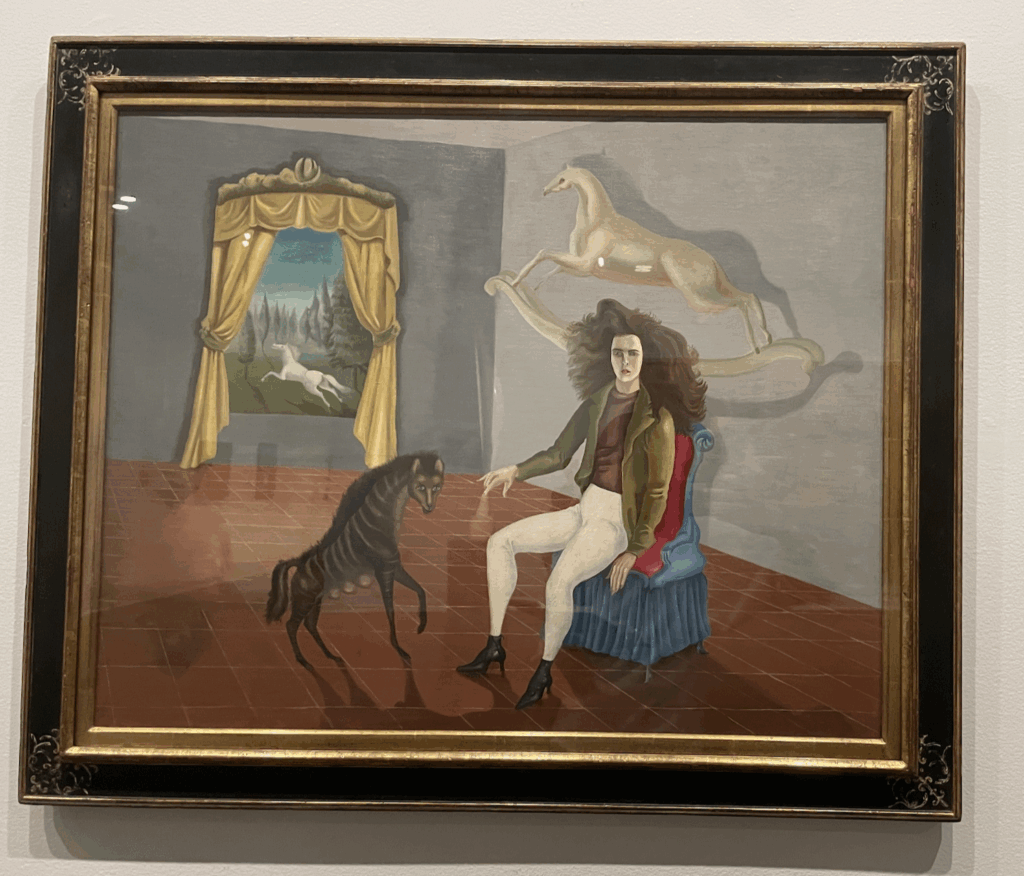
Carrington’s mystifying self portrait combines mythology and personal stories to confront the viewer in a protofeminist composition. The rocking horse references a story about Carrington’s strict father, which appears to meld into a white horse leaping out the window, representing freedom. The hyena is from a short story written by Carrington, where she befriends a hyena that, in Surrealist fashion, takes her place at lackluster social events, including a debutante ball. Carrington herself, sitting on the edge of a chair with a solemn expression and mane of hair, looks at the viewer as if to say she is not a force to be reckoned with.
Carrington exhibited early on at Peggy Guggenheim’s The Art of This Century gallery, and continued to show her work in New York. She started living and working in Mexico City in 1942, where the Surrealist movement was prevalent, and in 1947 was included in a New York group show of Surrealists as the only professional female painter. Carrington has remained highly relevant on the market today. Sotheby’s 2025 report of women artists listed Carrington as the 11th most valuable woman at auction, totaling over $75 million across 58 lots, and the top female artist of Latin American nationality. Further, she was named the top artist in a “power rank,” Sotheby’s ranking for growth in momentum and interest on the market.
Working Women
Clara Driscoll (American, 1881-1945)

Some of the most iconic products to come out of Tiffany Studios are their lamps with vibrant, jewel-colored glass shades that bridged art and craft. They reached peak popularity in the early 20th century, but would be replicated for decades to come. In recent years, it was revealed that designer Driscoll, head of Tiffany’s Women’s Glass Cutting Department from 1892 to 1909, was actually the mastermind behind some of the most eminent designs, including the Dragonfly Lamp. Today, it is hard to find one of these lamps for under $100,000.
Anni Albers (American, 1899-1994)

Though Albers studied at the German Bauhaus school and Black Mountain College in North Carolina, she is significant in New York history for being the first textile designer to have a solo show at The Museum of Modern Art. Albers practiced largely centered around handlooming mass-produced fabrics for domestic interiors, such as tablecloths and wall-hangings. Despite the seemingly impersonal and commercial nature of these items, Albers’ watercolor prototypes demonstrate the process of careful craftsmanship and artistic design akin to architectural blueprints or painters’ sketches.
Berenice Abbott (American, 1898-1991)
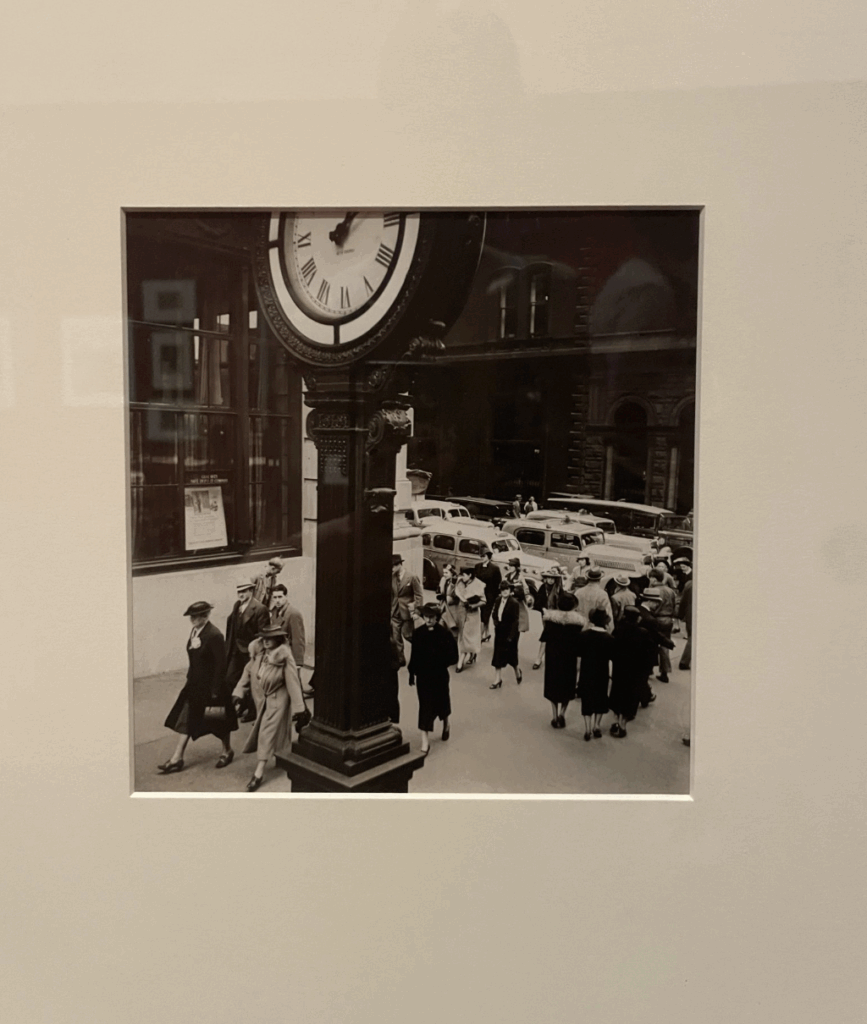
During the Great Depression, the Works Project Administration (WPA) employed artists to create works for public spaces, now a testament to the era’s democratization of art and essential role in making “New York City” and “art world” synonymous. Abbott’s Tempo of the City I was the product of her Federal Art Project, which would in turn make her one of the most known New York photographers of her time. Abbott captures the City’s quintessential bustle of pedestrians and car traffic from a cinematic high angle. This was one of the first photographic prints to enter the Brooklyn Museum’s collection.